When we talk about sun protection for children, we usually think of sunscreen and hats, but it’s important not to forget to protect children’s eyes from the sun’s UV rays. In fact, children are particularly vulnerable to sun-related damage, which can lead to both short- and long-term vision problems. Sunglasses are therefore essential for spending time outdoors, especially as the sun starts to come out.
The Dangers of the Sun to the Eyes.
Children’s eyes are more sensitive than those of adults because their lens (the part of the eye that focuses light on the retina) is clearer and therefore allows more UV rays to pass through. The lens does not begin to provide protection until age 12 and does not become fully functional until adulthood. Before that age, the lens allows more than 75% of UV rays to pass through, and between ages 0 and 1, 90% of UV rays reach children’s retinas.
Since children spend more time outdoors than the average adult, they are also more exposed to various risks, such as photokeratitis and photoconjunctivitis (inflammation of the cornea and conjunctiva, respectively). These conditions, which require treatment and are often painful, can, however, be easily prevented by wearing sunglasses.
It is therefore important to get a young child used to wearing appropriate sunglasses early on to protect their eyes from sun damage. So if you’re wondering, “At what age should a baby start wearing sunglasses?” our answer is “as early as possible.” Sunglasses will then be essential during prolonged sun exposure or in very bright light.
What is blue light?
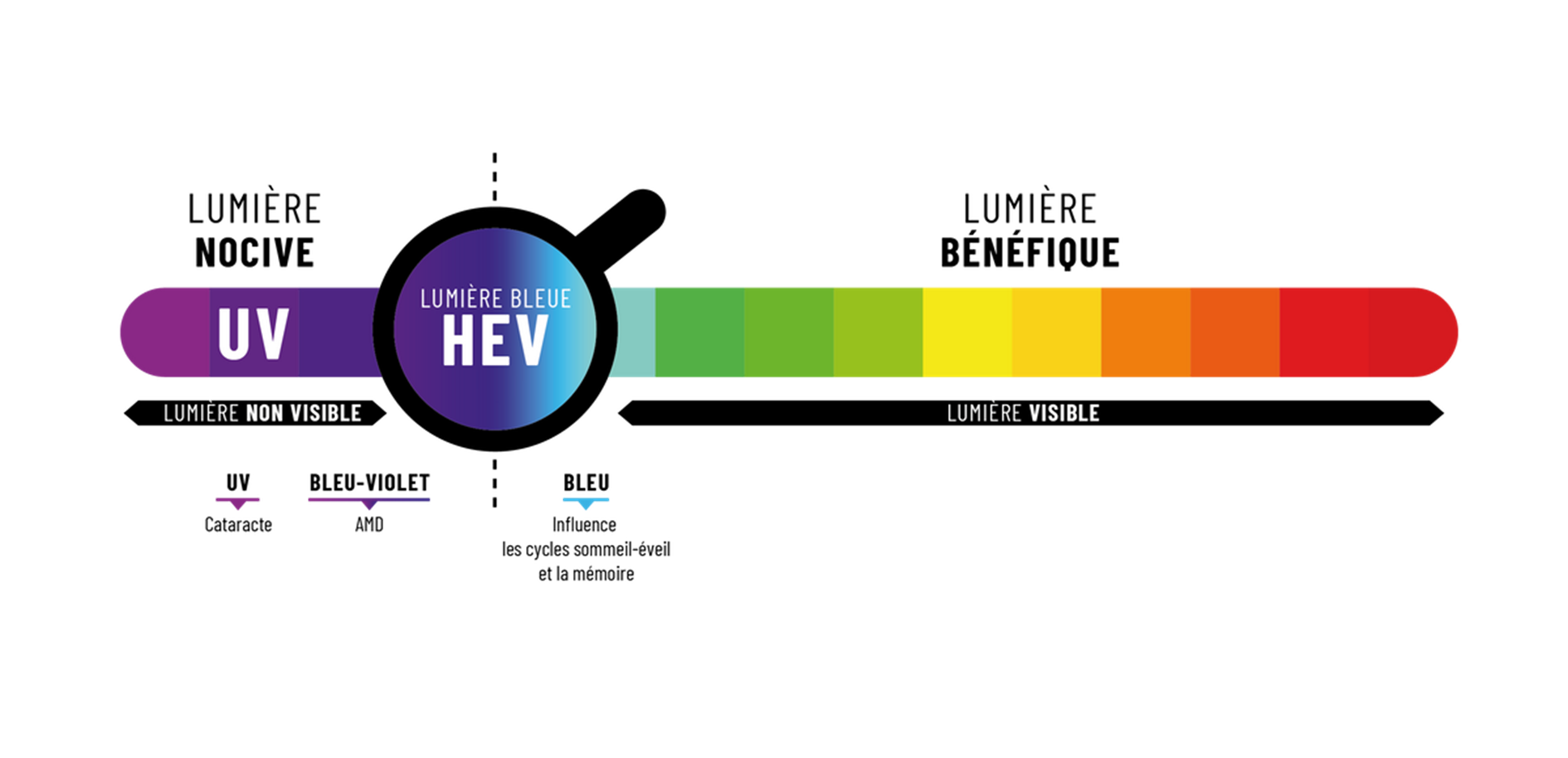
Also known as HEV (High-Energy Visible), blue light is the most energetic part of the visible spectrum and is recognized as being 15 times more harmful to the retina than other colors in the spectrum. In particular, HEV light causes photochemical damage to the retina, specifically affecting the retinal pigment epithelium and photoreceptors. These mechanisms of retinal cell damage are known to contribute to age-related macular degeneration (AMD)
Sunglasses are pretty stylish, after all!
They help reduce eye strain
Exposure to bright light can cause eye strain, so UV protection will reduce the effort required to block this light and will therefore be a significant help.
Immediate visual comfort
On sunny days, we tend to squint and our pupils constrict, but that’s not enough to protect our eyes. Sunglasses, on the other hand, reduce glare and provide immediate visual comfort.
Blocking Sun Glare
When you're at the beach, skiing, or even near a body of water, the sun's rays become more intense and can cause significant glare. Sunglasses will help protect your children's eyes from this bright light.
So, how do you choose sunglasses?
Category 0
They are not tinted and therefore do not protect your children's eyes; they are mainly used as prescription glasses or sports goggles and help protect the eyes from wind and dust.
Categories 1 and 2
They are only lightly tinted and are therefore also recommended for sports in low-light conditions or are generally used for aesthetic purposes.
Category 3
They're perfect for walks and outdoor activities in nice weather. This category is very popular and highly recommended for children.
Category 4
They are generally reserved for situations with extreme light conditions, such as on a boat or while skiing, where the sun’s glare is very strong. If these sunglasses are used in a “normal” situation, your child might find the view much too dark and probably wouldn’t want to wear them.
For babies aged 0 to 5 months
There's no need to make him wear sunglasses. However, it's still important to protect him from the sun with hats and to avoid the brightest hours of the day.
From 5 months to 2 years
It's important to choose glasses with an elastic strap to keep them in place on the child's face. Also, until the age of 2, a baby doesn't have a defined bridge of the nose, so it's necessary to choose a model with a rounded shape that fits the child's nose.
From 2 to 5 years old
It's important to choose comfortable, well-fitting sunglasses with flexible arms that don't leave marks. A strap is also recommended so your child doesn't lose them during their adventures.
From 5 to 7 years old
Instead, choose comfortable, lightweight glasses. You can also add a strap to make sure your child doesn't lose them, but this isn't necessary.
More than 7 years
Finally, for children over 7 years old, glasses can be similar to those worn by adults; the most important thing is to choose glasses that are right for them


 Français
 Deutsch
 Italiano
 Español