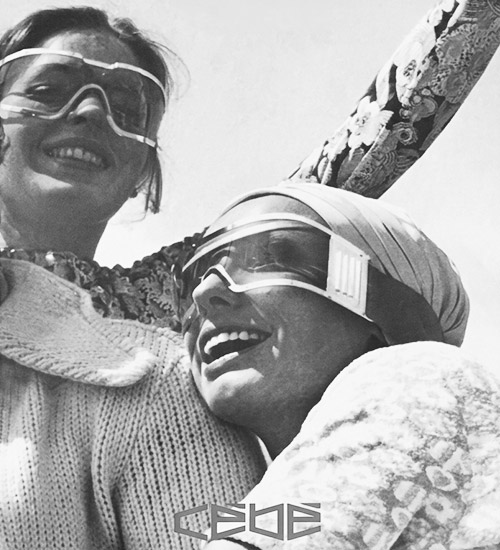
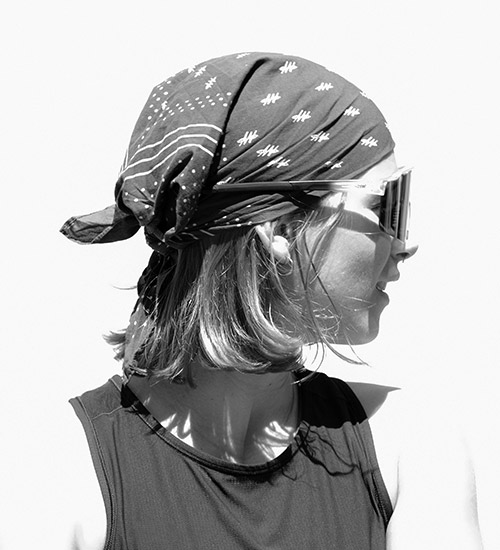
From 1980s cycling pelotons to rugby locker rooms and festival nights—how did the speed goggles become one of the most versatile items in contemporary sports?


Between these two images, joggers, trail runners, skippers, and other athletes from all sports: worlds apart, united by nothing but their eyes hidden behind a pair of wraparound sunglasses with a more or less aggressive profile. “Sport wrap” or “speed glasses” is the English term for these high-speed sunglasses. Full-rim or semi-rimless frames, more or less tinted wraparound lenses—you see them more and more every year, in an increasingly diverse range of settings, including… the city! It’s a story of engineering, media, and social change, and here it is.

Born to protect, not to please
the 1970s
In the 1970s, elite athletes such as cyclists and skiers faced a problem that was bothersome on several levels: traditional sunglasses didn’t stay in place. They slipped, didn’t sit securely on the nose, let in air, allowed pebbles and insects to enter from the sides, and their rigid temples posed a risk of injury in the event of a fall. Something new had to be invented.
The solution lay in a few design constraints that engineers of the time clearly defined: a one-piece frame that conforms to the contours of the face; wide, curved lenses that also cover the peripheral field of vision; and flexible, lightweight materials that are impact-resistant. Polycarbonate—this virtually unbreakable plastic—and the first engineering polymers, such as Grilamid, finally made it possible to produce these shapes without adding weight to the equipment.
Aesthetics don’t factor into the equation. These goggles are functional, almost brutal in their design. They protect the eyes from the wind, from UV rays at high altitudes, and from debris flying off the road at 80 km/h. They’re made to save time, not to earn compliments. In France, Cébé was among the brands that, even back then, understood that competitive sports would require a complete redesign of eyewear. Founded in Morez in the Jura region—the eyewear capital of the world—the company possessed the expertise to design these new technical frames. Downhill skiing was its primary testing ground at the time.
When the cameras arrive in the pack
The 1990s
The shift began in the 1990s and was closely linked to television. The Tour de France and the Olympic Games (1992, 1996) brought athletes’ faces into every home. Those unusual frames—wide and wraparound—were captured by the cameras, and little by little, speed glasses entered the collective unconscious. At the same time, certain sports like triathlon and mountain biking played a decisive role in making this style of glasses more accessible. These sports were being practiced by more and more amateurs, who began investing in their gear. Wraparound sunglasses became a desire before they were a necessity. In the 2000s, trail running and trail biking exploded in popularity, completing this process of widespread adoption. People ran in cities, from Paris to New York, but also in the countryside, on steep trails. They moved from shade to sunlight, from one street to the next or from one hillside to the other. Tunnels, sidewalks, wooded areas, paths strewn with roots and overhung by branches—we go everywhere… And we have to see where we’re stepping! Naturally, sports sunglasses became the go-to gear for millions of runners.
From the pack to the locker room... without warning
the 2010s
What happened next, we didn’t see coming. When objects become icons, they cease to belong to their original context.
In the mid-2010s, something was happening in the locker rooms of rugby clubs. Players began wearing sports sunglasses off the field—not for running or to protect themselves from the sun, but because the design—massive, bold, almost aggressive—resonated with something in their visual identity. The sports wrap became a locker-room accessory in the truest sense of the word.
The same phenomenon, coming from a different direction, was taking place on music stages. Rap and urban culture have always had a close relationship with sportswear, appropriating technical gear and repurposing it beyond its original use. Speed glasses fit perfectly into this logic: they’re visible, they have a strong presence on stage under the lights, and they convey the energy of performance and speed without needing a word of explanation.
This trend preceded and foreshadowed what the fashion world would come to call “athleisure”—the blurring of the line between athletic wear and everyday clothing. The speed goggles are one of the earliest and most interesting examples of this, precisely because they were not designed with any lifestyle concept in mind. They arrived at this point by cultural accident.
Electronic music festivals round out the picture. In these spaces where the boundaries between night and day, dancing and chilling, and indoors and outdoors blur, the speed glasses take on a new meaning. They truly protect the eyes—from the afternoon sun and strobe lights in the evening—and they signal a connection to a culture of intensity and movement. They say something about the person wearing them: their style, their mindset.
What Our Speed Goggles Say About Us
Today
Today, in 2026, the speed glasses are probably one of the most versatile pieces of sports equipment around. They’re worn by ultratrail runners at the 80-km mark of a mountain race and by people who haven’t run… since high school. They’re chosen by cyclists measuring their FTP and by festival-goers tracking their hours of sleep… . with the naked eye. They’re right at home in the locker rooms of elite athletes and on streetwear runways. This isn’t a contradiction, and one group isn’t any more credible for wearing them than the other! It’s a sign that this item has achieved something rare: uniting people around a shared implicit value—intensity, movement, light. The speed goggles are, in their very form, a statement of intent. They say: I know what I’m doing and where I’m going.
At Cébé, quality is a given for everyone. The manufacturing technologies that made it possible to produce lightweight, durable polycarbonate lenses for professional cycling are now available at a reasonable price to the general public. There’s no longer any need to compromise between fit, protection, and weight. The OUTFLOW delivers on its promises. And then there’s the design. Over the past fifty years, the cycling glasses have developed their own distinctive style while being available in a variety of colors, lens treatments, and finishes that allow them to adapt to any setting. They can be understated and discreet on a face along a trail in Provence, or bold and colorful at a concert or in the mosh pit. Versatility, without compromising on identity.
Designed for speed and to master the light.
From competition tracks to everyday roads, Cébé has been protecting your eyes for over a century. Discover the OUTFLOW 2: our second generation of speed glasses designed for both performance AND style. Running, trail running, cycling, mountain biking, or even water sports... OWN THE LIGHT.

Français
English
Deutsch
Italiano